by Joseph Potangaroa, Potangaroa Education
I write this piece in the hope that our endemic eels extend their species existence well beyond their current 80 million years on earth. To help them please remember that any eel killed in New Zealand has not bred. They breed once, sometimes after living one hundred years, and the breeding grounds are in the Pacific Ocean.
Eels, especially the tuna kuwharuwharu or New Zealand Longfin Eel are my favourite fish, actually one of my favourite animals and as it happens they are officially classified as “At Risk: Declining” in New Zealand. The International Union for Conservation in Nature (IUCN) lists them as Endangered. It just happens that some of my most memorable night time experiences involve eels.
Moving across the land
I have been involved in eel advocacy and education for around 25 years. A little prior to the start, I was at Henley Lake one night, being one who enjoys the different sites and sounds of the night.
It was about 10.00pm. I was walking between a pond and stream when an unfamiliar sound in grass to my left caught my attention. I went to investigate. Pointing my torch downwards in the direction of the sound, the beam illuminated two shortfin eels. As I watched them they moved forward across the dewy grass towards the stream. I didn’t know eels could travel overland until this moment. Later I saw them moving across sand, gravel, even up sloping banks.
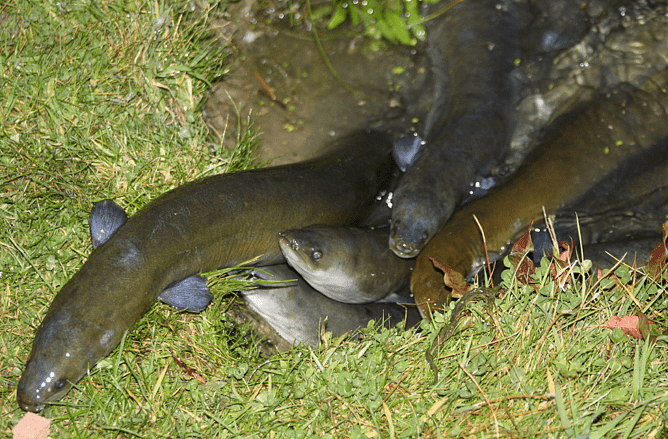
Shortfin eels coming out of a pond onto grass
Climbing up concrete walls
Our objective was to see if glass eels were swimming up the Akitio River on the northern Wairarapa coast.
To do so, three of us needed to get up at 3.00am then drive from the beach to a site half an hour inland. Then launch our small boat to move up the river with the incoming tide. We stopped by several small side streams where we observed a variety of endemic fish, some in good numbers.
We knew somewhere upstream was an old concrete weir which was evidently impassable. That would be where we tied up the boat and waited in anticipation with head lamps on and a bigger spotlight at the ready.
As we slowly moved onward the only sounds were the hum of our small outboard motor and an occasional call of a bird. Trees stood like sentinels on both banks with the moon shining through their branches onto the flat water with the only small ripples being created by the boat’s wake. On straight parts of the river the water looked like a dark road with the trees like giant people welcoming us from the berms.
Then around one corner a dark shadow came into view, something that spanned the whole width of the river. As we got closer we could see a sheer concrete wall several metres high. Down near the water was a narrow ledge and a number of limestone boulders that we could walk on.
After tying up the boat and having a snack we had a look in between the rocks. There were a few medium sized eels looking out but no glass eels. After 20 minutes we noted how the tide had made the river level rise. Shortly after something extraordinary happened.
There were a few glass eels at the bottom of the weir, then more and more. Then there were some on the ledge, then hey wait a minute some are climbing straight up the concrete wall. Interestingly they were using a line of moss that had grown where a trickle of water was going downwards due to crack up the top of the weir.
For the next hour we, truthfully more I, watched thousands of baby glass eels, inanga and shrimp climb straight up and over a four metre high vertical concrete wall. INCREDIBLE! Thankfully I had gotten into the habit of carrying around a waterproof camera so I captured footage and photographs of the tiny fish achieving this amazing feat.
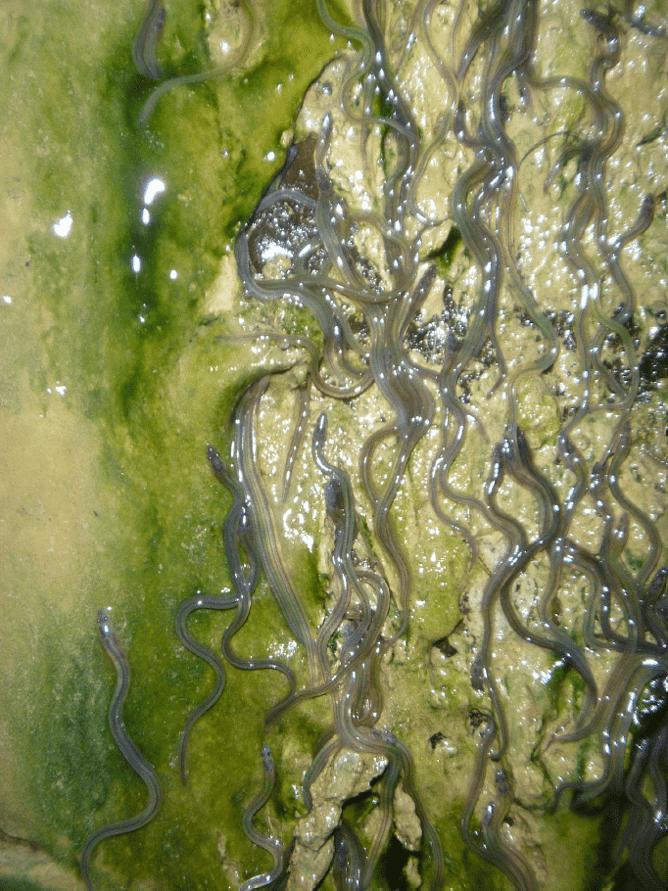
Glass eels and elvers climbing the concrete weir at Akitio
Count, catch, release
We were at Castlepoint, working in the stream and in the surf by the beach. The job was to catch glass eels and hopefully not much “by catch” in either large fyke nets in the stream or by big hand held scoop nets in the surf. We set up before high tide, worked through the incoming tide, then departed when the tide was going out. Checking nets hourly and using the scoop nets throughout. Some nights were quiet, others full on where we were in the surf for hours, only taking a quick break. There was a lot more to record but essentially once fish were caught, they were counted and recorded by species, then most were returned straight away and a sample later on.
The sea is to be respected all times. Working throughout the night meant we came away with a heightened appreciation of why. But it was great, unforgettable.
The top of the hill above the stream merged with the sky as a dark curtain was drawn across the land. A thick blanket of cloud hid the soft light of the moon and stars.
Now it was pitch black other than white dots and blue hues from street lights beside the road reflecting on grass and outwards across the beach.
Looking out towards the ocean nothing was seen but there was the noise of waves crashing on the sand and then lapping against the boots of our waders. We quickly learnt baby fish used darkness for protection to avoid predators when moving inland.
Wave after wave pushed the water further up the beach until it rushed up the narrow channel of the stream, highlighting the power of the ocean. Experience soon told us the back surge, when the water came back down the stream, had even more strength.
Calm dry weather allowed for a warm fire made from driftwood and old fennel stalks. Accompanied by a hot drink, good yarns and soaking up the surroundings.
Sometimes the stars, moon and satellites were so vivid that all you did was sit back and appreciate their beauty. Or sometimes consider bigger questions about life and the universe. We observed the fish didn’t move as much during these stunning nights, which made us wonder whether we were doing anything useful. It turned out the information we were gathering was worthwhile. I thought our tupuna would have known all of this and here we were in the same place relearning.
Another night a storm could be exhilarating. Wind bending trees, whipping up waves, blowing sand and making it hard to see. Driving rain requiring multiple layers of clothing to stay dry and warm. No fires on those nights, rather hunkering down under trees or make-shift bivvies or in really tough conditions sheltering beside the toilet block.
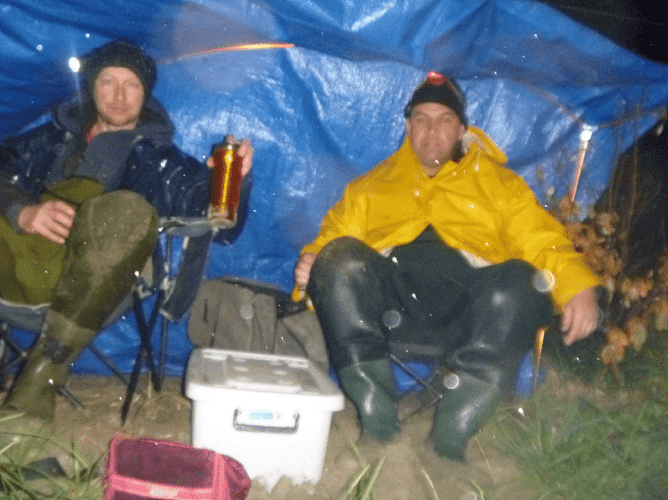
Mikis van Geffen and Joseph Potangaroa on a wet night at Castlepoint
Some days we saw the sun go down, others we watched it rise, in between we got to experience all sorts of sights, sounds, smells, touching and some tastes of the beach at a time everyone else was tucked up in bed. Overall, working throughout the night at Castlepoint was so much fun, something that will never be forgotten.
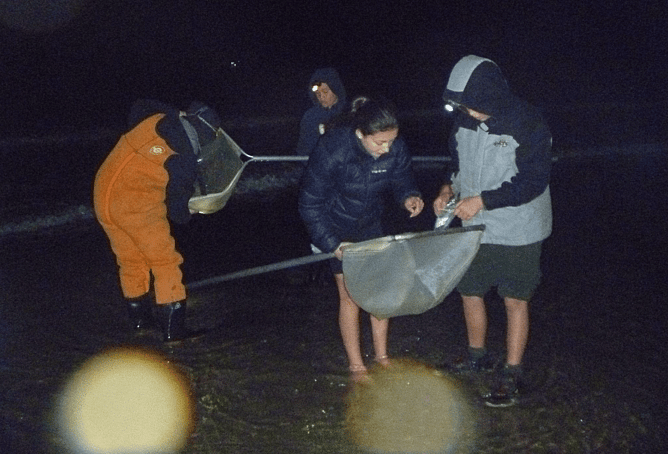
Children checking scoop nets early in the morning
Please note: You are not normally allowed to fish at night. The project we were undertaking had been approved by the Ministry of Primary Industries, Department of Conservation, and the National Institute of Water and Atmospheric Research (NIWA) .
Enjoy the night
I enjoy the night, always have. It is like you enter into a different world. My experiences with eels at night has given me many smiles but more so a better appreciation of them and other lifeforms that we share our places with.